 Cento
Financial education at every age: what the research says
What children, teenagers and adults gain from learning about money, how big the effects are, how long they last, and what it means for Romania.
Most of us learned about money by watching our parents and by making our own mistakes. Very few of us had a class about it. This article looks at what researchers know about financial education at each stage of life, from the first years of childhood to adulthood: what it changes, how much, and for how long.
The short answer is that it helps. Learning about money reliably improves what people know, and it improves what they do by a smaller amount. The effect is strongest when the lesson arrives close to a real decision, and it fades when nothing reinforces it.
Three questions researchers use
Much of the research on adults uses three simple questions, written by economists Annamaria Lusardi and Olivia Mitchell. You can try them now:
- You have $100 in a savings account at 2% interest a year. After 5 years, will you have more than $102, exactly $102, or less than $102?
- Your savings earn 1% a year and prices rise 2% a year. After a year, can you buy more, the same, or less with that money?
- Is buying shares in a single company usually safer or riskier than buying a fund that holds many companies?
The answers are: more than $102, less, and riskier. In the United States, only 43% of adults answer all three correctly. About a third of young adults do, and the gap between women (29%) and men (48%) is large (Lusardi and Mitchell, 2023). Worldwide, a survey by S&P Global found that about one adult in three is financially literate.
Early childhood: the building blocks
You may have read that “money habits are set by age 7”. The line comes from a 2013 literature review by researchers at the University of Cambridge for the UK Money Advice Service. The review gathered existing research on how young children learn. It did not follow children into adulthood, so it can’t show that adult habits are fixed at 7.
What it does say is still useful. By about 7, most children can count money, understand that money is earned and that it buys things, plan ahead and wait for something they want. These are the skills that good money habits are built on later. One of the authors, David Whitebread, also noted that simply giving children information about money doesn’t work well at this age. Practice does.
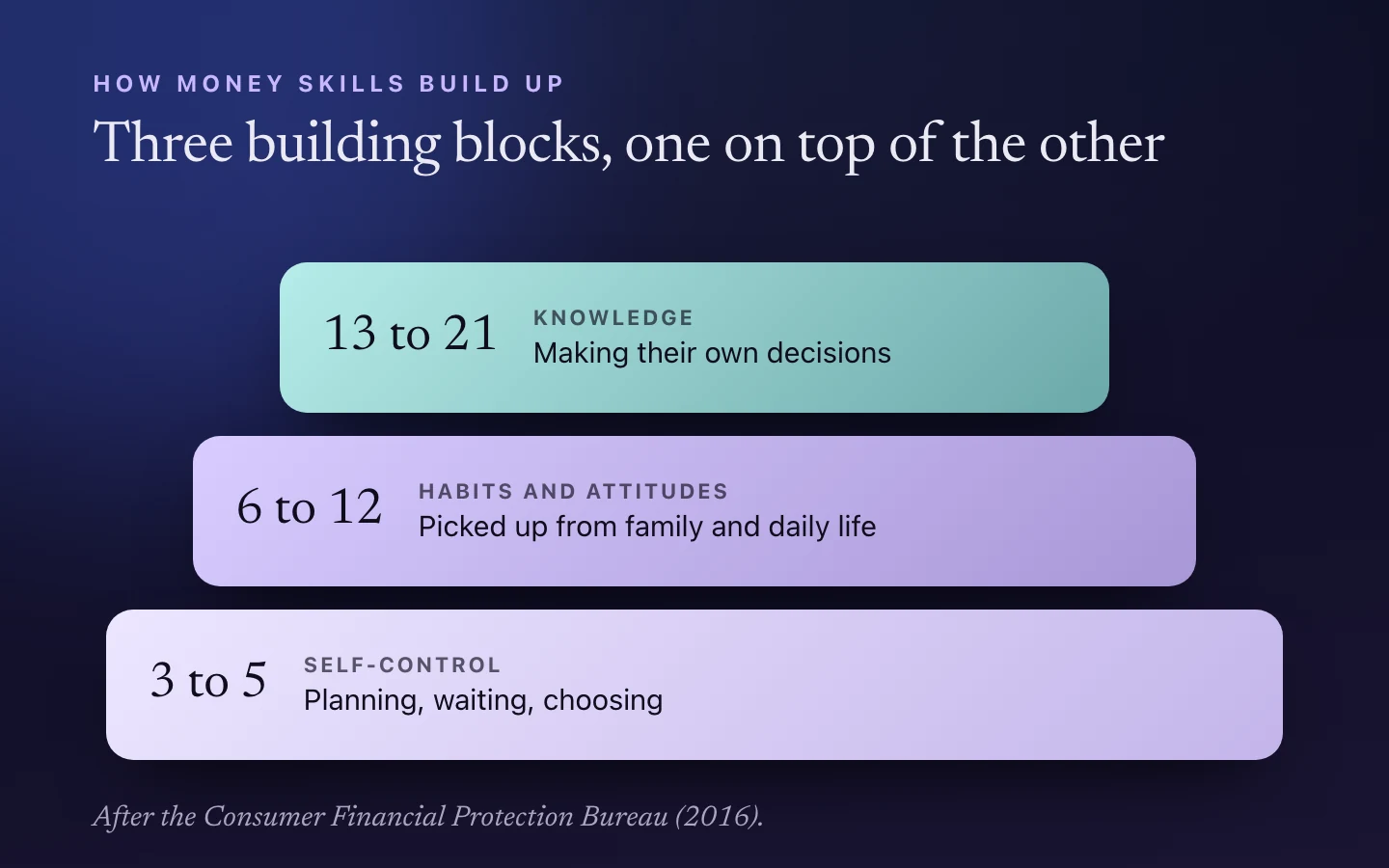
The US Consumer Financial Protection Bureau describes a similar path. Between about 3 and 5, children build self-control and planning. Between 6 and 12, they pick up habits and attitudes about money. From 13 onward, they build the knowledge to make their own decisions.
What this means at home: for a young child, saving coins in a jar for a small toy, choosing between two things, and waiting a few days for something they want are the real lessons.
Primary school: what children learn at home
For children between about 6 and 12, the research mostly comes from following families over time, and it points to conversation more than to money itself.
Pocket money on its own shows mixed results. Studies find it helps mainly when parents talk with the child about how it is used. Research from the Netherlands found that adults whose parents taught them to save were more likely to save as adults, and saved more. A study in the United States found that adults who had a savings account as children were more likely to own financial assets later.
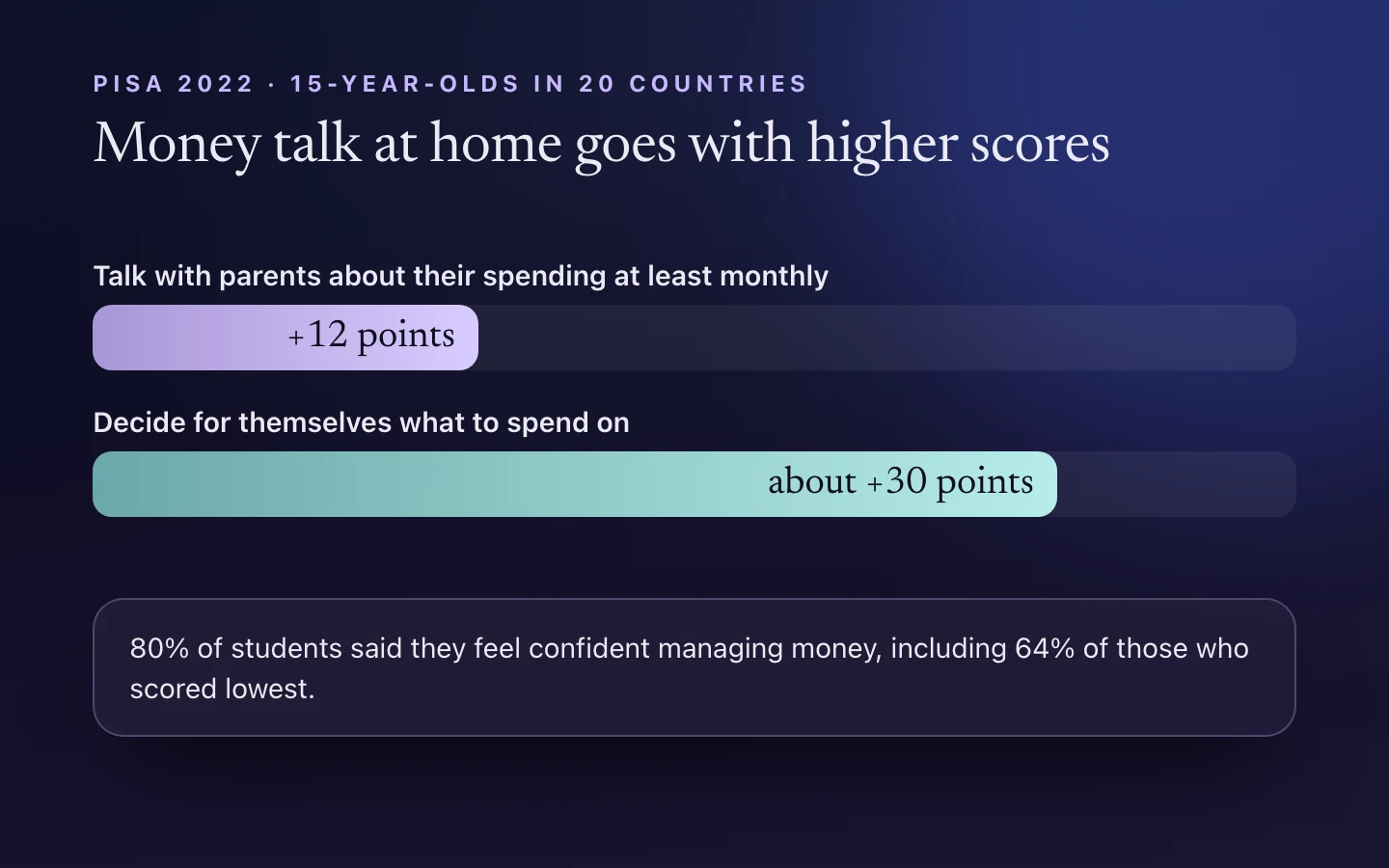
The OECD’s PISA tests point the same way. In 2022, 15-year-olds in 20 countries took a financial literacy test. Those who talked with their parents about their own spending at least once a month scored 12 points higher than those who never did. Those who could decide for themselves what to spend on scored about 30 points higher. These are links in the data, and they don’t prove that talking causes the higher score. They do fit with everything else we know.
Teenagers: what school courses change
Teenagers have the strongest evidence, because many countries have tested school programmes with proper experiments.
A review of 37 school studies by economists Tim Kaiser and Lukas Menkhoff found that financial education clearly improves what students know, and changes their behaviour by a smaller amount. Large trials show the same:
- Brazil: a programme in 892 schools with about 25,000 students improved knowledge, saving and budgeting. Parents learned from their children too. Students also borrowed more and fell behind on payments more often, and the researchers linked this to a course that covered saving but left out credit.
- Peru: in 300 schools, students’ knowledge improved, and so did their teachers’. The teachers who took part became more likely to save in a bank.
- Spain: ten hours of lessons for about 3,000 students in the ninth grade improved their knowledge, mostly among students from poorer families, and they talked about money more at home.
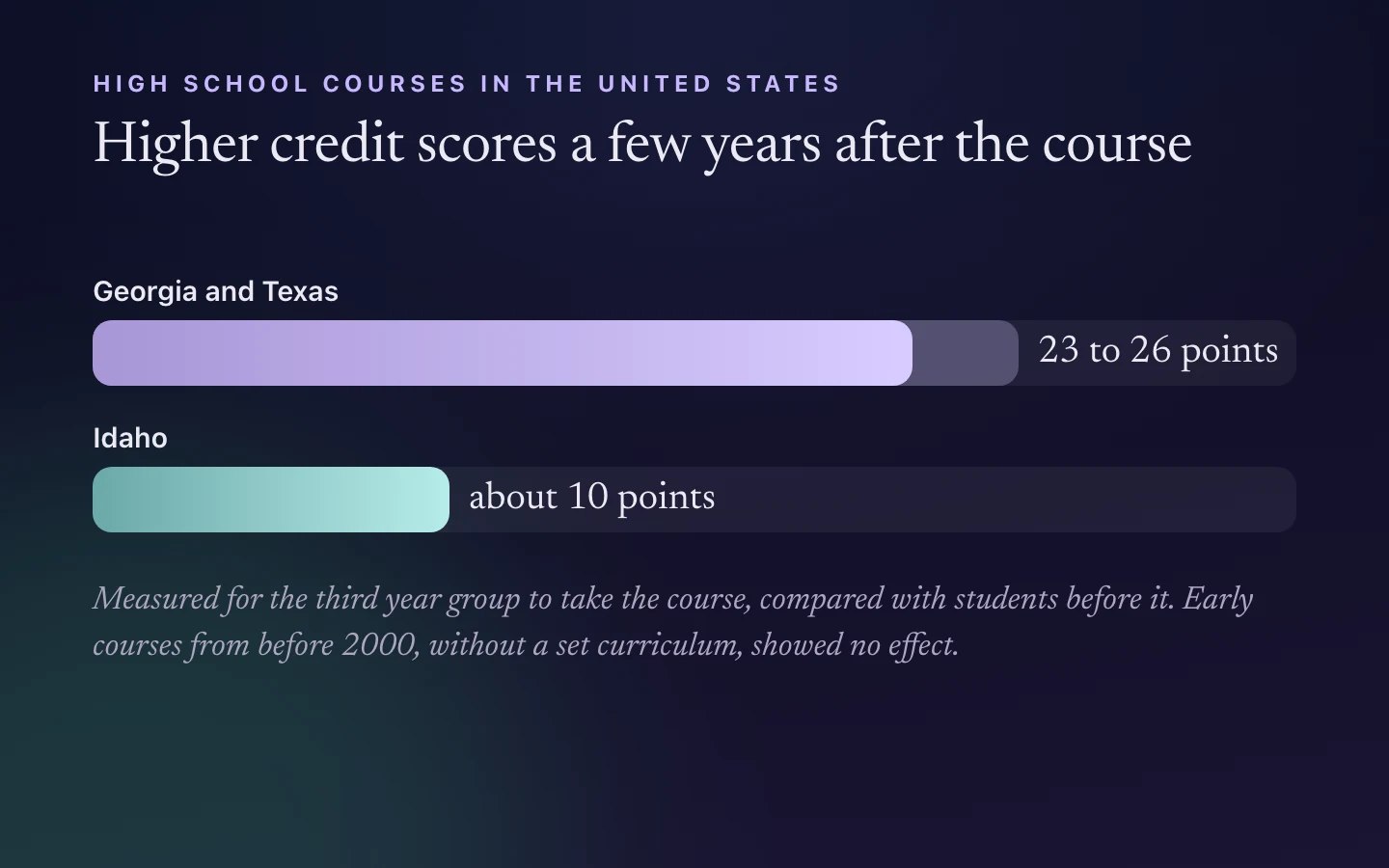
The United States offers the longest view, because states introduced required personal finance courses at different times. The early rules from before 2000, often loosely defined, showed no effect. Later courses in Georgia, Texas and Idaho came with proper curricula and teacher training. Researchers followed students into their twenties using credit records. By the third year group to take the course, credit scores were about 23 to 26 points higher in Georgia and Texas and about 10 points higher in Idaho, and fewer young people fell behind on payments (Urban and colleagues, 2020). Other studies found less use of payday loans and better repayment of student loans. By April 2026, 30 US states required a personal finance course before graduation.
PISA also asked students how confident they feel managing money. 80% said they feel confident, and so did 64% of the students who scored lowest on the test. Many teenagers feel ready before they have the skills, which is one more reason to teach credit before their first loan or card.
The lesson from Brazil: what the course covers matters. A course for teenagers should include credit and debt, because that is what they meet first.
Adults: knowing and doing
Among adults, people who know more about money tend to have much more of it. In US data, people who answered all three questions above correctly had about 45% more net wealth than those who didn’t, after accounting for other differences between them (Lusardi and Mitchell, 2023). Lusardi and Mitchell are careful to say this is a link, and that they don’t know how much of it is caused by the knowledge. People who are patient or good with numbers may be both more literate and wealthier.
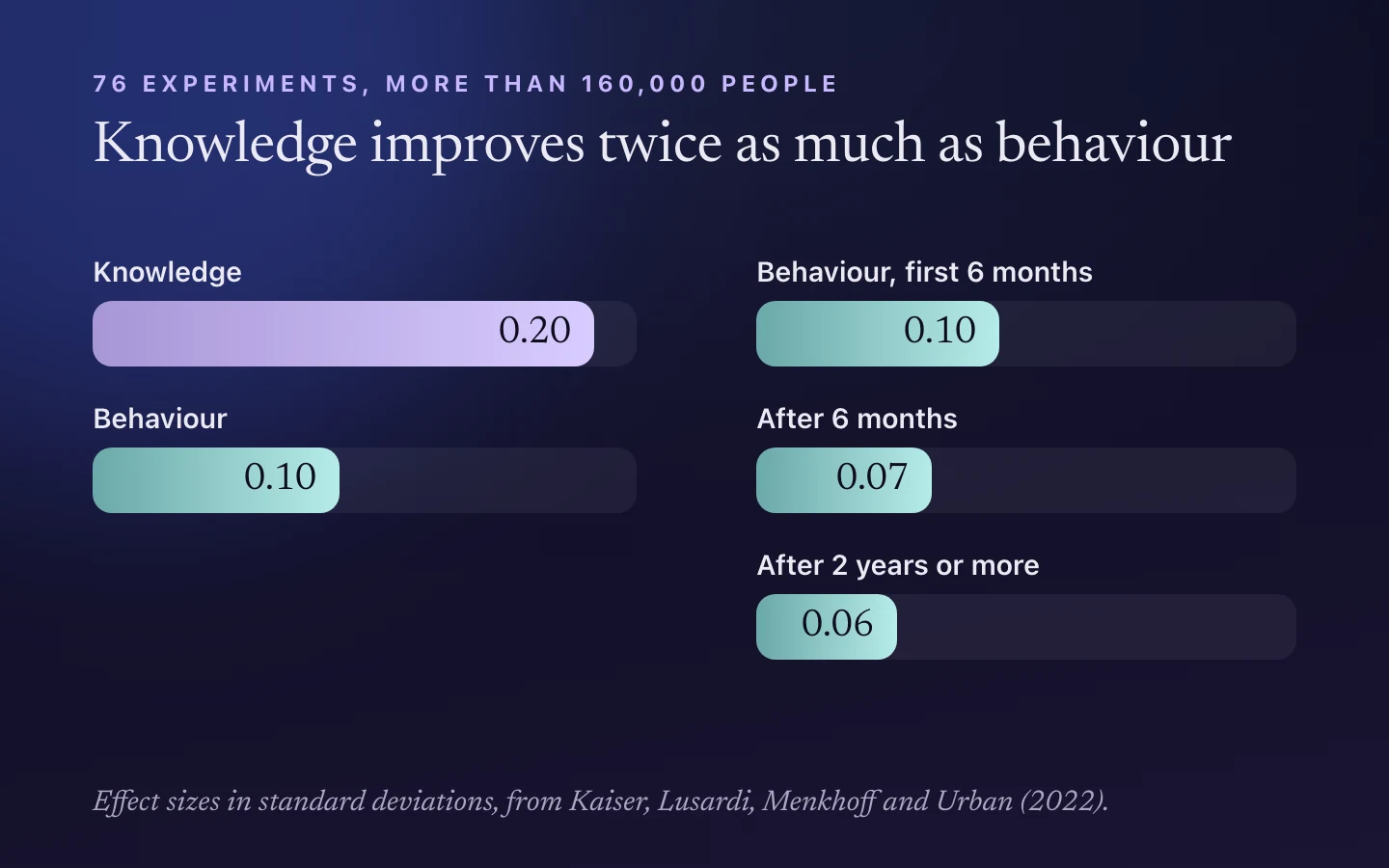
To find out what teaching actually changes, researchers run experiments. The largest review so far, by Tim Kaiser, Annamaria Lusardi, Lukas Menkhoff and Carly Urban, combined 76 randomised trials with more than 160,000 people. In practical terms:
- Knowledge improves clearly. The researchers compare the effect to other education programmes and describe it as large for the field.
- Behaviour improves about half as much. The gains show up mostly in saving and budgeting.
- Debt is the hardest to change. Results for credit behaviour vary too much to draw a conclusion.
- The effect fades. It is smaller after six months, and still smaller after two years, though few studies follow people that long.
- It is cheap. The average programme cost about $60 per person.
An earlier review, by Daniel Fernandes, John Lynch and Richard Netemeyer, read the evidence more pessimistically. It found that effects faded to almost nothing after about 20 months. Both groups agree on what works best: help that arrives at a “teachable moment”, right before a real decision such as a first loan, a mortgage or a first salary.
Some researchers go further. Law professor Lauren Willis argues that courses can make people overconfident and that better rules for financial products would help more. Behavioural economists point to defaults: when one US company started enrolling new employees in its pension plan automatically, participation rose to 86%, compared with 37% under the old system (Madrian and Shea, 2001).
Seeing your own numbers also seems to help. In Iceland, people who started using a personal finance app paid fewer bank fees and penalties. In the United States, access to a budgeting app on the phone reduced spending on non-essentials. In the UK, text alerts and banking apps cut overdraft charges by 5 to 8%. One study found the opposite effect too: when people are more certain how much money they have left, some of them spend more of it. How the information is shown matters.
What the research can’t tell us yet
A few things to keep in mind:
- Most effects are modest. Financial education helps, and it is one factor among income, prices, family and luck.
- Few studies follow people for years. We know much less about the long term than about the first months.
- Many findings are links. Talking about money at home and having more savings go together, and the research can’t always say which causes which.
- Some researchers have a stake. Several of the authors above run centres that promote financial education. Their methods are sound, and it is fair to know.
Romania
Romania is an interesting case, because the gap shows up in specific places.
In a global survey from 2014, only 22% of Romanian adults were financially literate, the lowest share in the European Union, where the average was 52%. The figure is more than ten years old, and the OECD’s 2023 adult survey gives a newer picture:
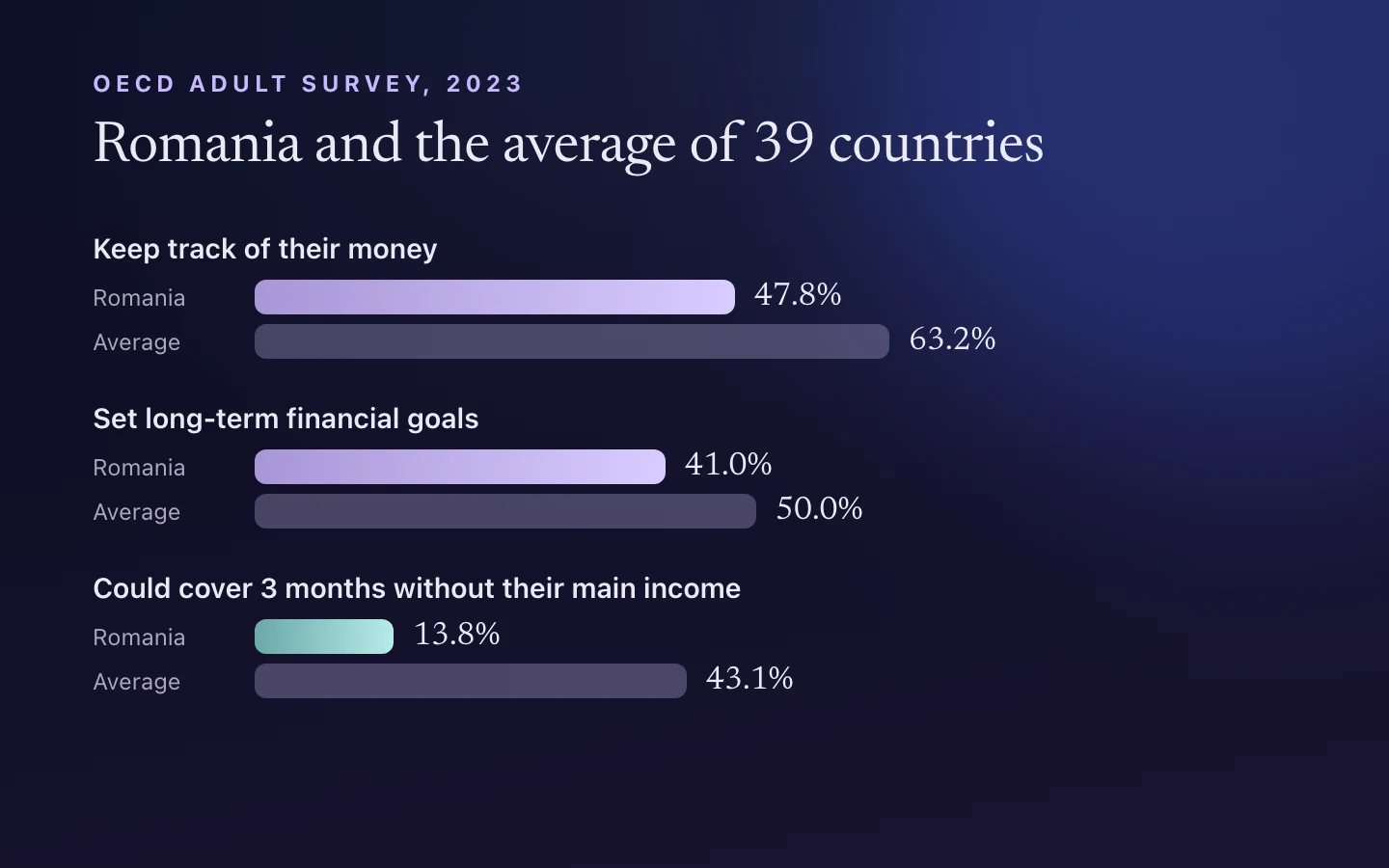
Romania’s overall score was 54.0 out of 100, against an average of 60.4.
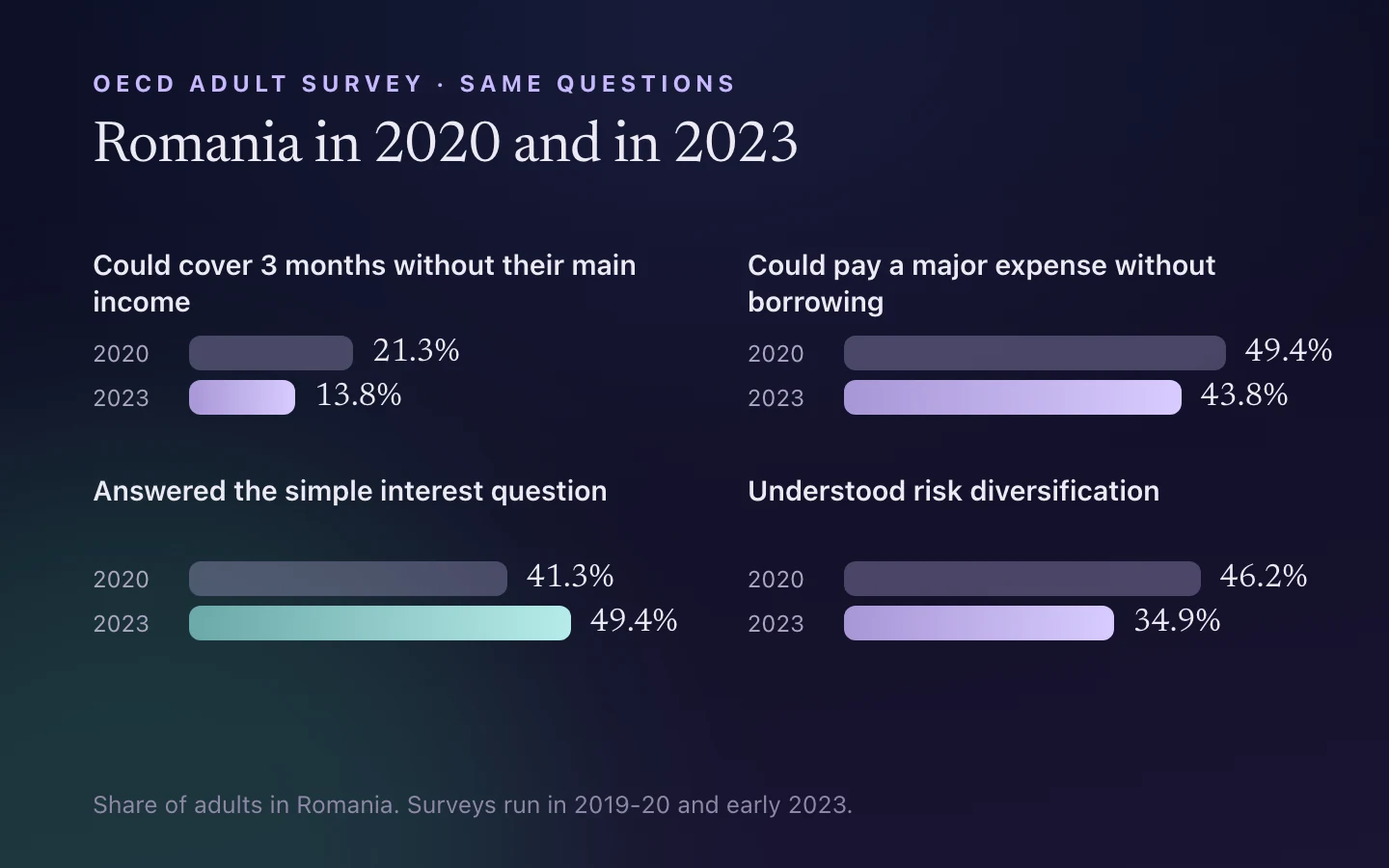
Romanians’ attitudes to saving are about the same as the average, and slightly better on some questions. The gaps are in keeping track of money, setting goals and having savings to fall back on. Romania took part in the same OECD survey in 2019 and 2020, so some answers can be compared over time. The share who could last three months without their main income fell from 21.3% in 2019 and 2020 to 13.8% in 2023 (OECD, 2023). Fewer people could pay a major expense without borrowing (43.8%, down from 49.4%), and fewer understood risk diversification (34.9%, down from 46.2%). More people answered the simple interest question correctly (49.4%, up from 41.3%). The survey doesn’t say why the savings figures dropped. The timing likely played a part: the 2023 interviews took place early that year, after prices in Romania rose 12% in 2022, and in 2022 Romanian households as a whole spent more than they earned, with a saving rate of −7.6%.
In 2025, according to Eurostat, 37.8% of Romanians could not pay an unexpected expense, against 29.2% across the EU.
The country has started to act. In 2021, a change to the education law made financial skills a required competence in primary and lower secondary school. A National Financial Education Strategy for 2024 to 2030 was adopted in April 2024, and pupils in grade 8 have a compulsory subject that includes economic and financial education. New high school plans start in September 2026. While they were being drafted, the education minister said financial education would be taught within economics and mathematics, without a subject of its own. Romania has never taken part in the PISA financial literacy test, and its first participation is planned for 2029.
At EU level, only 18% of people have a high level of financial literacy, according to a 2023 Eurobarometer survey. In September 2025 the European Commission published a financial literacy strategy for the EU, which countries follow on a voluntary basis.
What you can do at each age
Putting the research together:
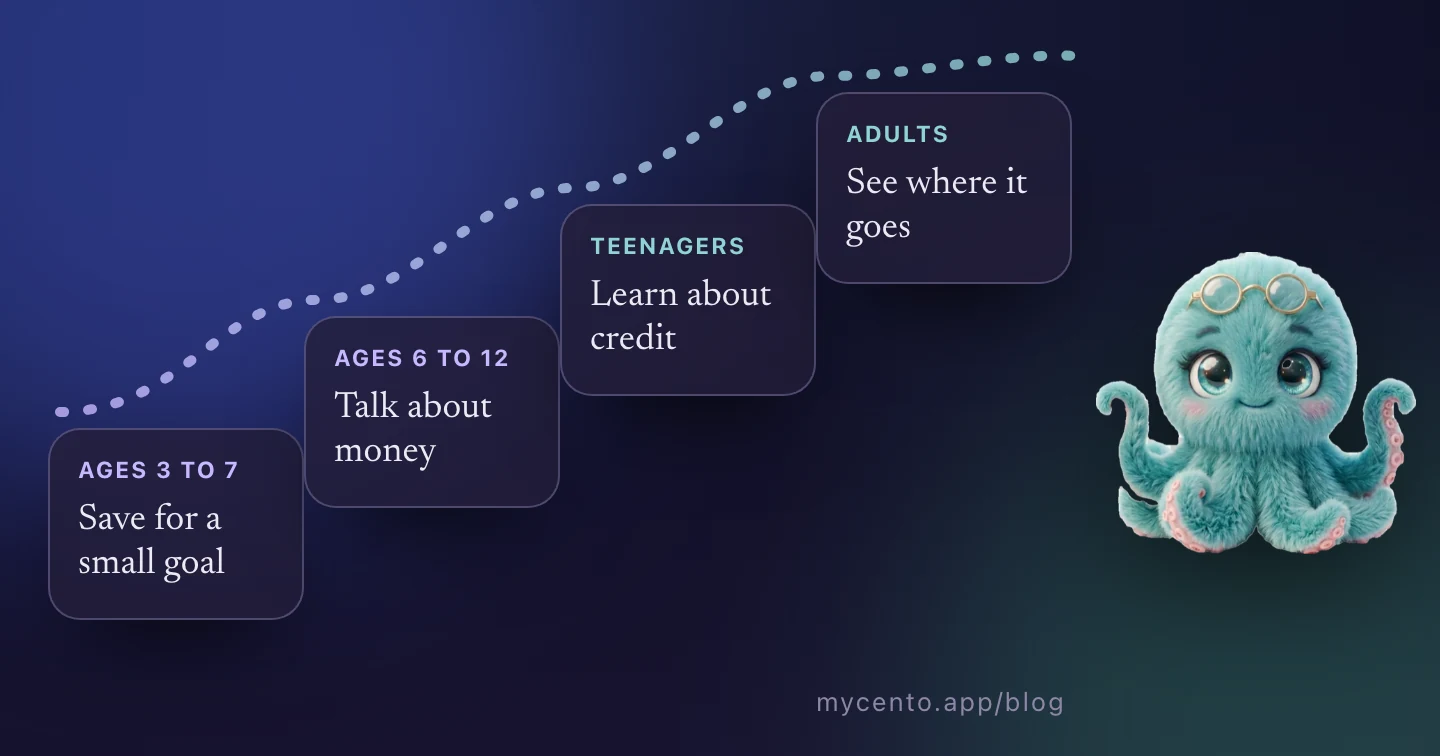
- Ages 3 to 7: practise waiting, choosing and saving for something small. A jar of coins is enough.
- Ages 6 to 12: talk about money at home. If you give pocket money, talk about how it is used.
- Teenagers: let them make real spending decisions, and make sure they learn about credit and debt before their first loan or card.
- Adults: learn at the moments that matter, such as a first salary, a loan, a move or a new child. Keep track of what you spend, so the numbers are in front of you when you decide.
Keeping track with Cento
Keeping track is one of the habits where Romania is furthest behind: fewer than half of Romanians do it, against 63% on average. It is also the one most people give up first, because typing in every receipt takes time.
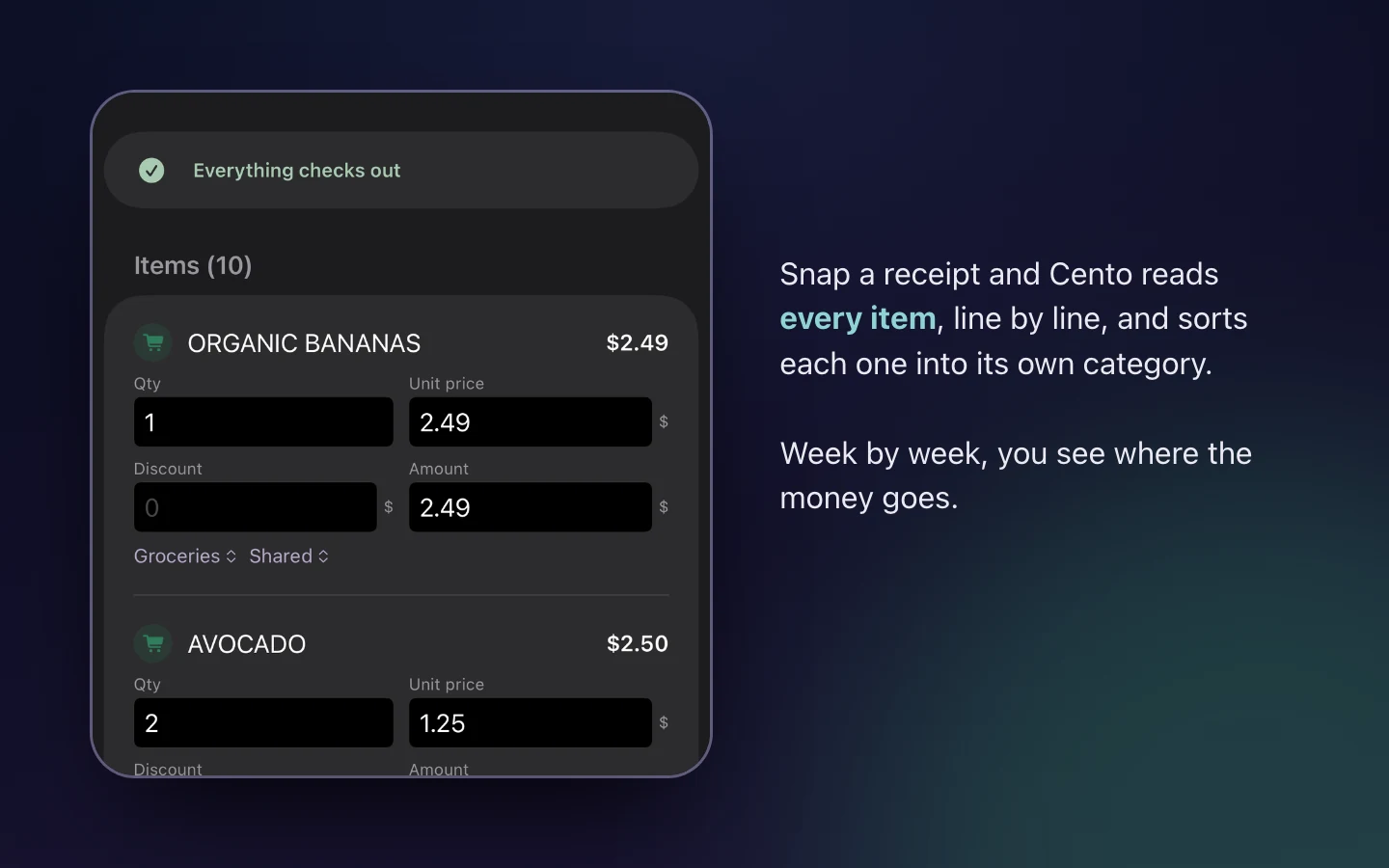
With Cento, you snap a photo of a receipt and it reads every item, line by line, and sorts each one into its own category. You see where the money really goes, week by week, in any currency, without connecting a bank. If you share expenses with a partner or family, everyone sees the same numbers, which also makes it easier to talk about money at home.
Sources
- Bover, O., Hospido, L., & Villanueva, E. (2018). The impact of high school financial education on financial knowledge and choices: Evidence from a randomized trial in Spain. Banco de España Working Paper 1801. bde.es
- Carlin, B., Olafsson, A., & Pagel, M. (2017). FinTech adoption across generations: Financial fitness in the information age. NBER Working Paper 23798. nber.org/papers/w23798
- Consumer Financial Protection Bureau (2016). Building blocks to help youth achieve financial capability. consumerfinance.gov
- Consumer Financial Protection Bureau. Youth financial education: literature review (Brazil trial and US state requirements). consumerfinance.gov
- European Commission (2025). A Financial Literacy Strategy for the EU, COM(2025) 681. commission.europa.eu
- Eurostat (2026). HICP annual inflation, dataset prc_hicp_aind, and household saving rate, dataset tec00131. ec.europa.eu
- Eurostat (2026). Inability to face unexpected financial expenses, dataset ilc_mdes04. ec.europa.eu
- Fernandes, D., Lynch, J. G., & Netemeyer, R. G. (2014). Financial literacy, financial education, and downstream financial behaviors. Management Science, 60(8), 1861-1883. ssrn.com
- Financial Conduct Authority (2015). Occasional Paper 10: Message received? The impact of annual summaries, text alerts and mobile apps on consumer banking behaviour. fca.org.uk
- Frisancho, V. (2018). The impact of school-based financial education on high school students and their teachers: Experimental evidence from Peru. gflec.org
- Kaiser, T., & Menkhoff, L. (2020). Financial education in schools: A meta-analysis of experimental studies. Economics of Education Review, 78. docs.iza.org
- Kaiser, T., Lusardi, A., Menkhoff, L., & Urban, C. (2022). Financial education affects financial knowledge and downstream behaviors. Journal of Financial Economics, 145(2). nber.org/papers/w27057
- Klapper, L., Lusardi, A., & van Oudheusden, P. (2015). Financial literacy around the world: Insights from the Standard & Poor’s Ratings Services Global Financial Literacy Survey. gflec.org
- Lusardi, A., & Mitchell, O. S. (2023). The importance of financial literacy: Opening a new field. Journal of Economic Perspectives, 37(4). nber.org/papers/w31145
- Madrian, B. C., & Shea, D. F. (2001). The power of suggestion: Inertia in 401(k) participation and savings behavior. Quarterly Journal of Economics, 116(4). nber.org/papers/w7682
- OECD (2023). OECD/INFE 2023 International Survey of Adult Financial Literacy. oecd.org
- OECD (2024). PISA 2022 Results, Volume IV: How financially smart are students? oecd.org
- Urban, C., Schmeiser, M., Collins, J. M., & Brown, A. (2020). The effects of high school personal financial education policies on financial behavior. Economics of Education Review, 78. federalreserve.gov
- Willis, L. E. (2008). Against financial literacy education. Iowa Law Review, 94. researchgate.net
- Romania: HG 378/2024, National Financial Education Strategy 2024-2030. anaf.ro