 Cento
Your personality and your money: what the research says
Why some people save without trying and others always run short. What studies on personality, self-control and spending found, and how to use it.
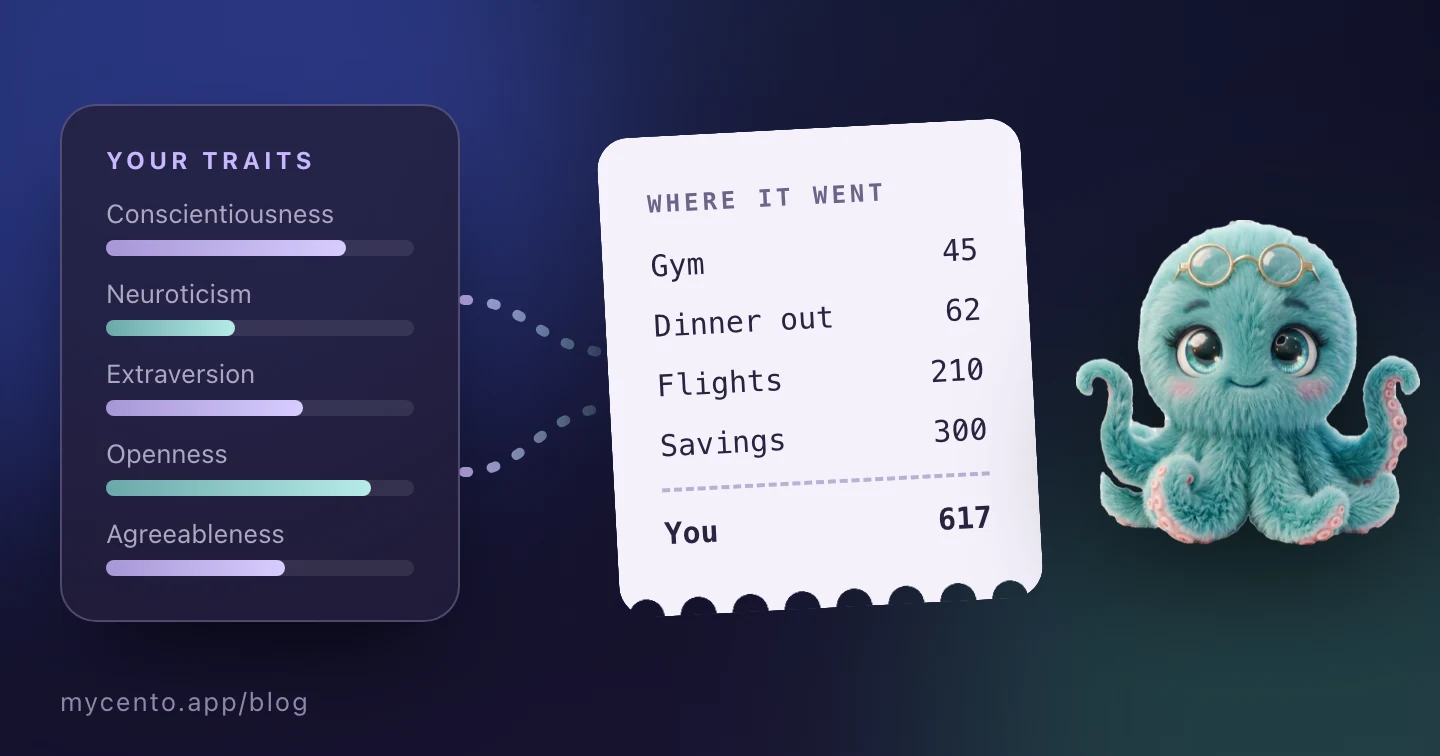
Two people earn the same salary. One ends the month with money left over without really trying. The other works just as hard, checks their balance more often, and still runs short. Income explains part of the gap. A growing body of research says personality explains another part.
Psychologists and economists have spent years comparing people’s personality traits with their savings, their debt and their bank statements. Here is what they found, what it means for you, and what you can do with it.
The five traits researchers measure
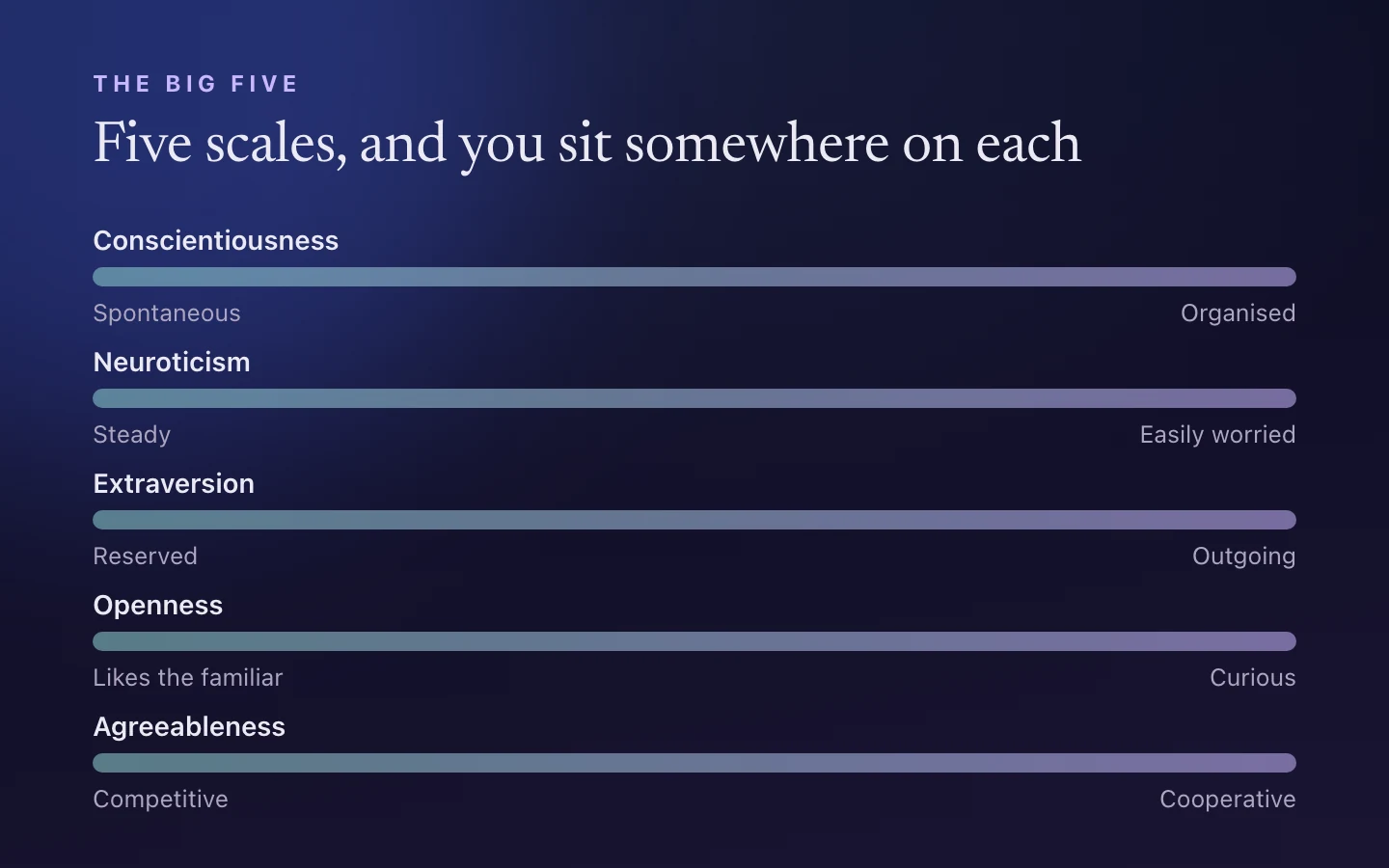
Most of the studies use the “Big Five”, the most widely used model of personality in psychology. It describes everyone along five scales:
- Conscientiousness: how organised, careful and goal-driven you are.
- Neuroticism: how easily you feel worry, stress and other negative emotions.
- Extraversion: how much you seek out people, excitement and new experiences with others.
- Openness to experience: how curious you are and how much you enjoy new ideas and places.
- Agreeableness: how warm, trusting and cooperative you are.
Nobody is simply “high” or “low”. Each trait is a scale, and every person sits somewhere along all five.
Conscientiousness: the strongest link
Of the five, conscientiousness shows up most often in the money research.
In a set of four surveys, Grant Donnelly and colleagues found that highly conscientious people manage their money more actively, and that people who manage their money have higher savings, lower debt and less compulsive buying. That held after the researchers accounted for income, age and other differences between people.
A study of young adults in the United States by Yilan Xu and colleagues found the same pattern from another angle: more conscientious young adults reported less financial distress, while those higher in neuroticism reported more.
The most striking evidence comes from New Zealand. The Dunedin study has followed about 1,000 people since they were born in 1972 and 1973. Researchers measured how much self-control each child showed between the ages of 3 and 11, then checked in on them at 32. Children with more self-control grew up to have better health and fewer money problems, and the link held after accounting for their IQ and the family they grew up in. It also worked as a gradient: every step up in childhood self-control went with somewhat better outcomes, across the whole group.
What it means for you: if planning comes naturally, you already have an advantage. If it doesn’t, the good news is that the useful part of conscientiousness is a set of habits: knowing what you spend, deciding ahead of time, checking in regularly. Habits can be borrowed, even if the trait isn’t yours.
Extraversion: more fun, more credit card debt
Sarah Brown and Karl Taylor analysed thousands of households in the British Household Panel Survey. Extraversion turned out to be one of the traits most clearly tied to household finances. Extraverts were more likely to carry credit card debt, while conscientious people were less likely to.
It makes sense when you think about where the money goes. Dinners, drinks, trips and birthdays are social, and saying yes to people is part of being an extravert.
What it means for you: this is no reason to stay home. It helps to see your social spending as one number for the month, so you can choose the evenings that matter most to you.
Neuroticism: worry about money is real
People higher in neuroticism tend to report more financial stress, as in the Xu study above. Worry can push people in two directions: some avoid looking at their accounts at all, and others check them constantly without feeling any better.
What it means for you: a clear, regular picture tends to help more than avoidance or constant checking. Ten minutes once a week, looking at real numbers, replaces a vague feeling with something you can act on.
Tightwads and spendthrifts: the pain of paying
Some research looks past the Big Five at one specific feeling: how much it hurts to pay. Scott Rick, Cynthia Cryder and George Loewenstein measured this “pain of paying” in more than 13,000 people.
Tightwads feel it strongly and spend less than they themselves would like. Spendthrifts barely feel it and spend more than they would like. Most people sit in between. Tightwads outnumbered spendthrifts by about 3 to 2.
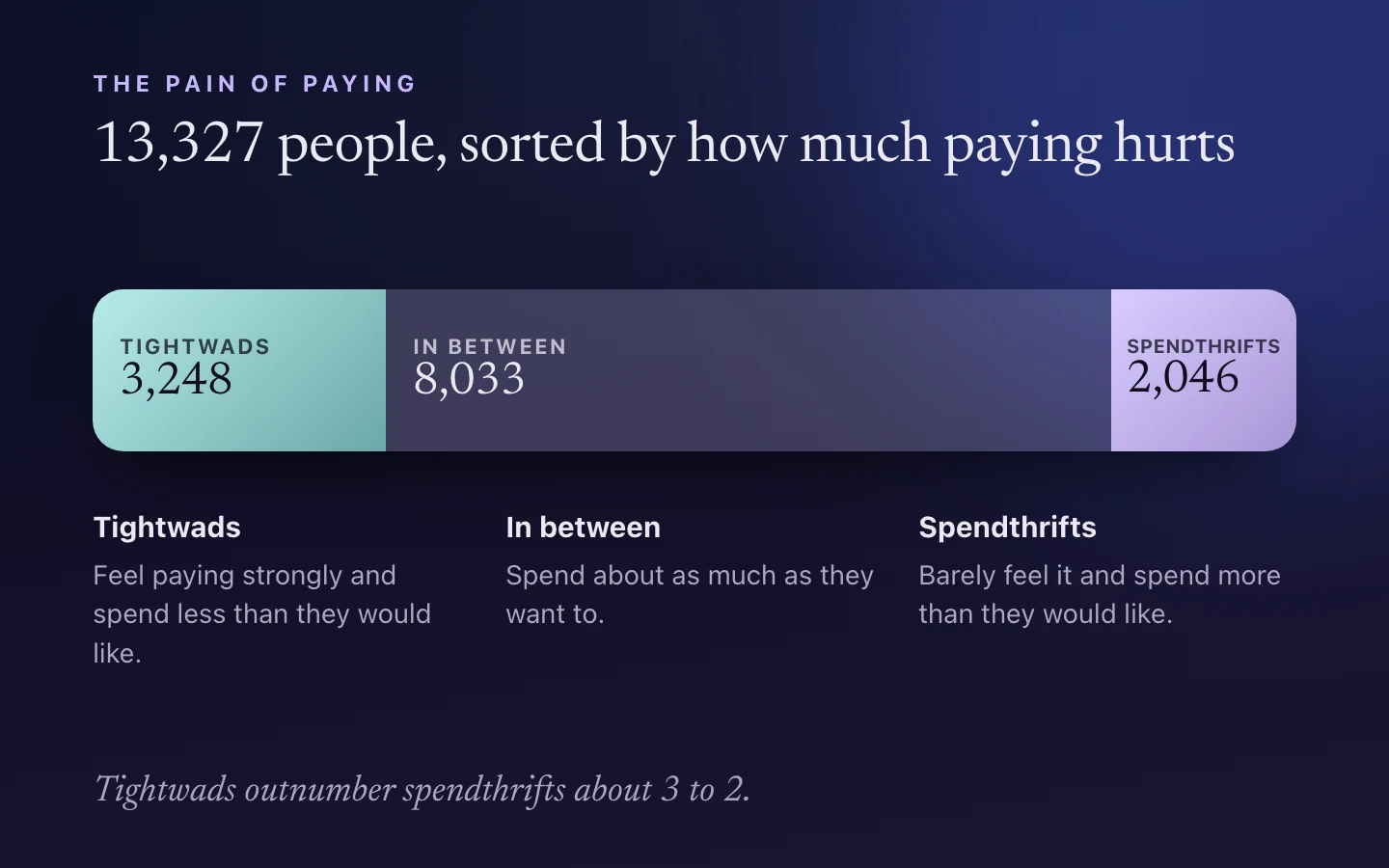
Two findings stand out. Scores on this scale were strongly related to credit card debt and savings, and only weakly related to income, so the differences seem to come from spending habits more than from how much people earn. And the gap between the two groups was widest in situations where paying felt painful, and smallest where it didn’t.
What it means for you: if you’re a spendthrift, anything that makes a purchase feel real helps, like seeing your total for the week. If you’re a tightwad, it can help to plan a little spending ahead of time, so that money for things you value doesn’t feel like a loss.
Money scripts: beliefs you picked up early
Financial psychologist Brad Klontz and colleagues asked 422 people how much they agreed with 72 beliefs about money. Four patterns came out:
- Money avoidance: money is bad, or people with money are greedy.
- Money worship: more money would solve my problems.
- Money status: my self-worth is tied to my net worth.
- Money vigilance: be careful, save, and keep your finances private.
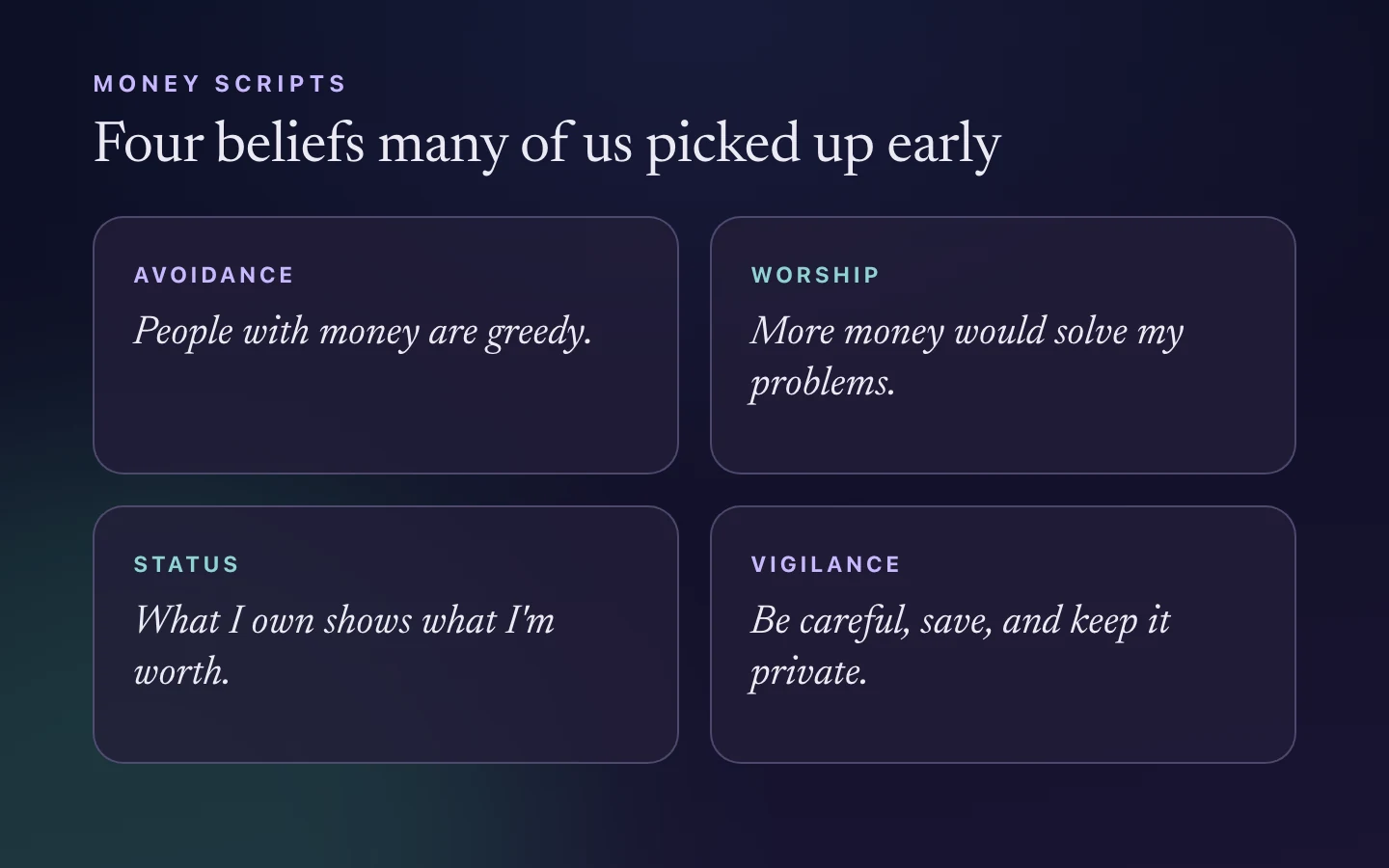
Three of the four were linked to people’s income and net worth. These beliefs are often learned in childhood, from what parents said and did around money, and many people hold them without ever putting them into words.
What it means for you: reading the list and noticing which one sounds like you is already useful. A belief you can name is easier to question.
Spending that fits you makes you happier
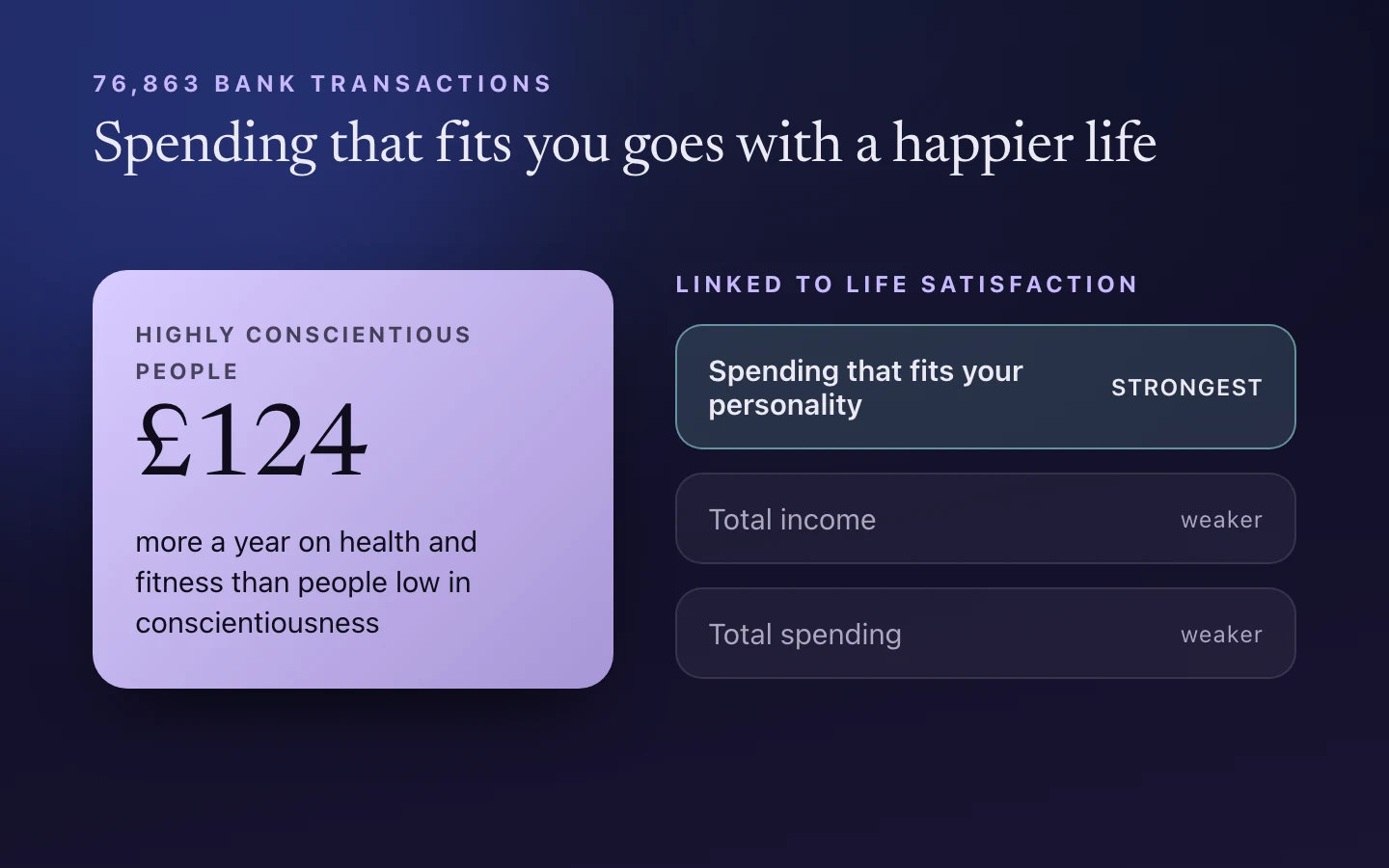
The most encouraging study in this field looked at real bank data. Sandra Matz, Joe Gladstone and David Stillwell worked with a UK bank to compare 76,863 transactions from 625 customers with the customers’ personalities.
People spent more on things that matched their personality. A highly conscientious person spent about £124 more a year on health and fitness than someone low in conscientiousness, for example. And the people whose spending fitted their personality best were more satisfied with their lives. That link was stronger than the link with their total income or their total spending. A follow-up experiment found the same effect: spending matched to personality lifted people’s mood.
A later study by Gladstone, Matz and Alain Lemaire went the other way, using two million transactions from more than 2,000 people to see whether spending can reveal personality. Some links were clear, such as more open people spending more on flights and people with more self-control paying less in bank charges. The predictions were modest, though. Your spending says something about you, and a lot of it is still up to you.
What it means for you: the goal is to spend in a way that fits who you are. Money on the things you value is money well spent. The money that leaks into things you don’t care about is what’s worth finding.
What personality can’t tell you
A few things to keep in mind:
- These are tendencies across large groups. They describe averages, and plenty of extraverts have no debt and plenty of conscientious people struggle.
- Most of the findings show links. They don’t prove that a trait causes an outcome. Personality is one factor among many, alongside income, prices, family and luck.
- Traits are not destiny. Personality changes slowly over a lifetime, and habits can change much faster.
Seeing where your money goes
Every study above starts with the same thing: knowing where the money actually goes. Most of us guess, and the guess is usually off.
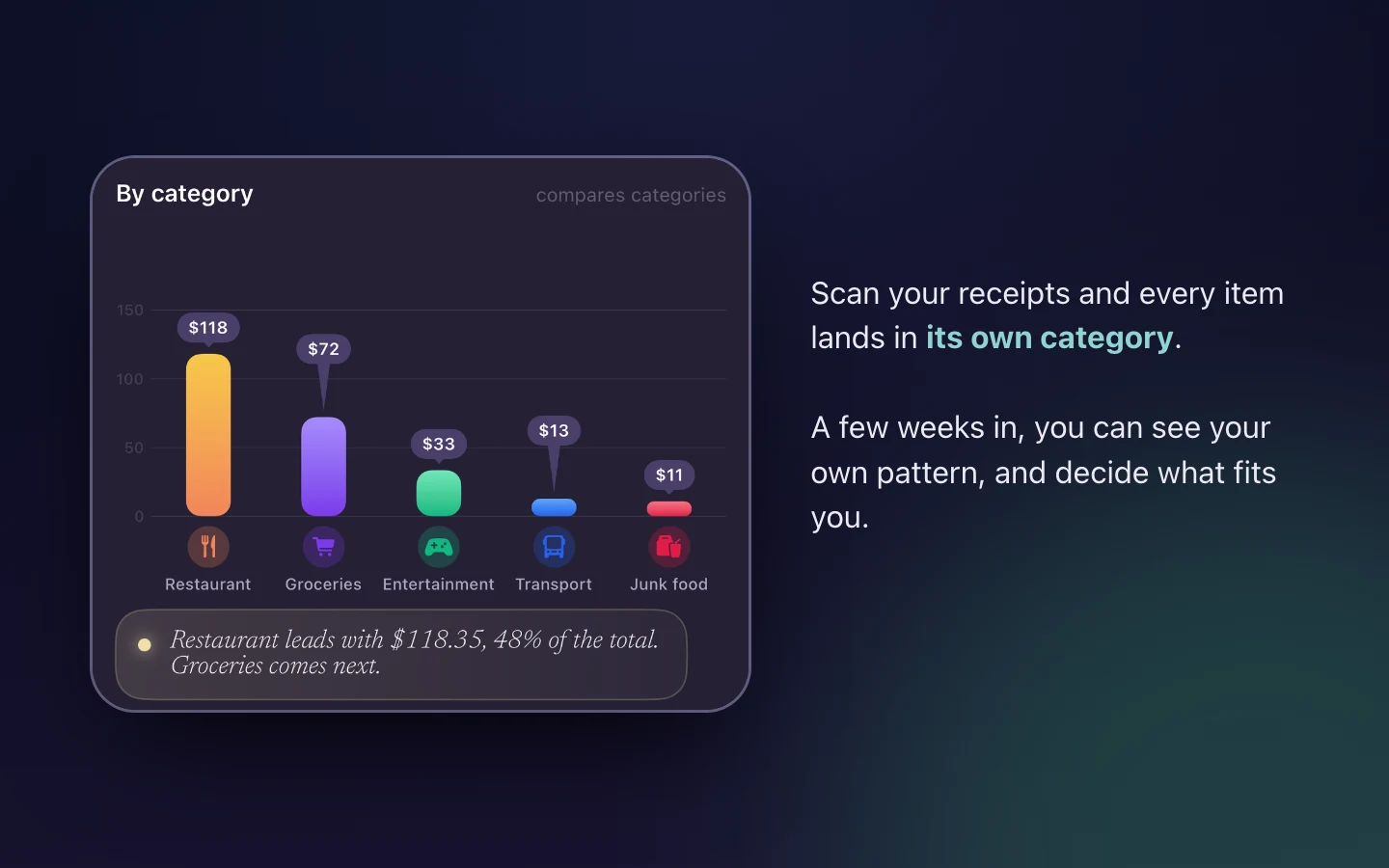
Typing in every receipt takes ages, so most people stop after a week. With Cento, you snap a photo of a receipt and it reads every item, line by line, and sorts each one into its own category. Groceries, eating out, a gift, something for the house: you see each of them separately, even when they were on the same receipt, and in any currency.
After a few weeks you can see your own pattern. How much goes to evenings out, how much to things you’d forgotten about, how much to the things you really care about. Then you can decide what to change, in a way that fits your personality.
Sources
- Brown, S., & Taylor, K. (2014). Household finances and the “Big Five” personality traits. Journal of Economic Psychology, 45, 197-212. doi.org/10.1016/j.joep.2014.10.006 (free version)
- Donnelly, G., Iyer, R., & Howell, R. T. (2012). The Big Five personality traits, material values, and financial well-being of self-described money managers. Journal of Economic Psychology, 33(6), 1129-1142. doi.org/10.1016/j.joep.2012.08.001
- Gladstone, J. J., Matz, S. C., & Lemaire, A. (2019). Can psychological traits be inferred from spending? Evidence from transaction data. Psychological Science, 30(7), 1087-1096. doi.org/10.1177/0956797619849435
- Klontz, B., Britt, S. L., Mentzer, J., & Klontz, T. (2011). Money beliefs and financial behaviors: Development of the Klontz Money Script Inventory. Journal of Financial Therapy, 2(1). doi.org/10.4148/jft.v2i1.451
- Matz, S. C., Gladstone, J. J., & Stillwell, D. (2016). Money buys happiness when spending fits our personality. Psychological Science, 27(5), 715-725. doi.org/10.1177/0956797616635200
- Moffitt, T. E., Arseneault, L., Belsky, D., et al. (2011). A gradient of childhood self-control predicts health, wealth, and public safety. Proceedings of the National Academy of Sciences, 108(7), 2693-2698. doi.org/10.1073/pnas.1010076108
- Rick, S. I., Cryder, C. E., & Loewenstein, G. (2008). Tightwads and spendthrifts. Journal of Consumer Research, 34(6), 767-782. doi.org/10.1086/523285
- Xu, Y., Beller, A. H., Roberts, B. W., & Brown, J. R. (2015). Personality and young adult financial distress. Journal of Economic Psychology, 51, 90-100. doi.org/10.1016/j.joep.2015.08.010