 Cento
How to split money as a couple: 3 ways that work
Fifty-fifty, proportional to income, or one shared pot. How each one works, when it feels fair, and how to choose together without a fight.
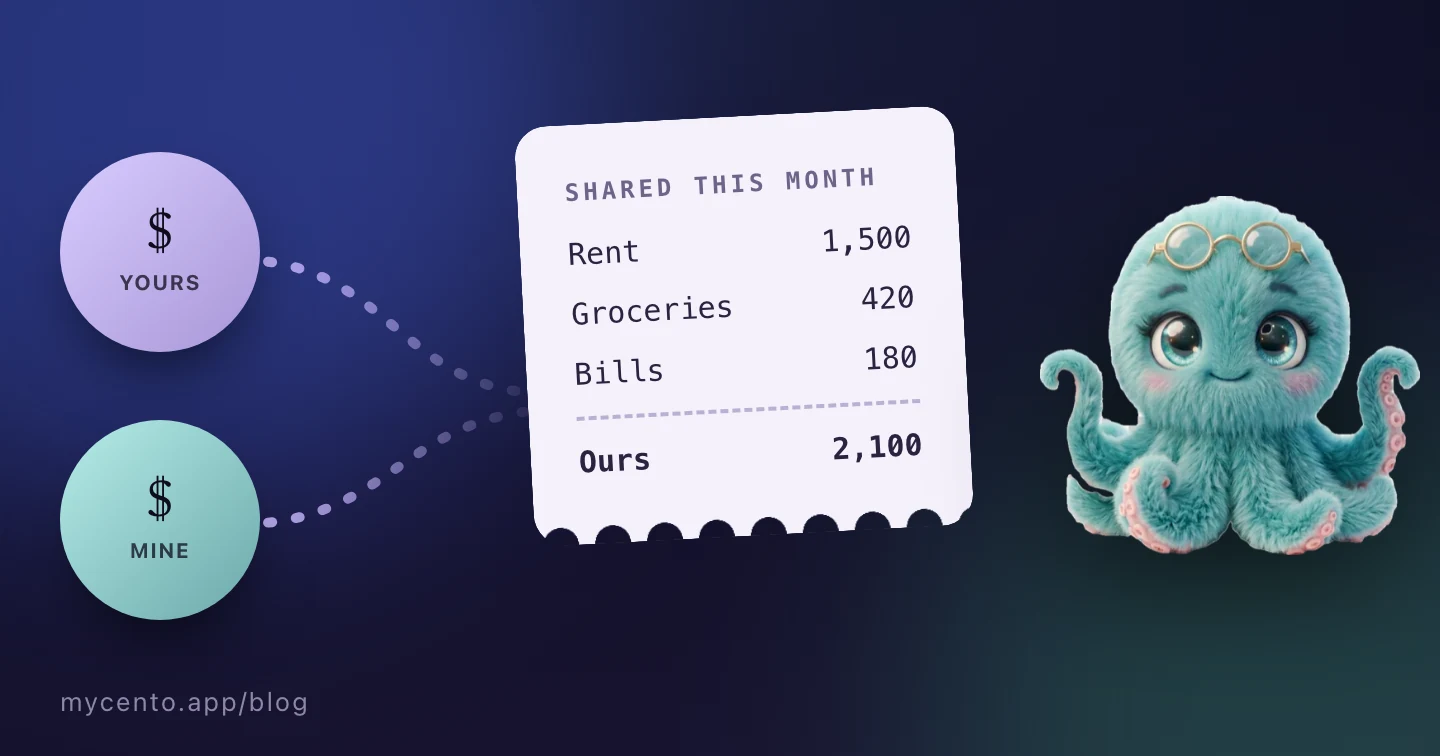
Money is one of the things couples argue about most, and the argument is rarely about the numbers. It’s about fairness. Who pays for the groceries? Why does one of you always seem to cover dinner? Is it fair to split rent down the middle when one of you earns twice as much?
There is no single right answer. There are three common ways couples share costs, and each one is fair in a different way. Here is how they work, with real numbers, so you can pick the one that fits you both.
Before you choose: two questions
What counts as shared? Start by agreeing which costs belong to both of you. Rent or mortgage, utilities, groceries and household supplies are almost always shared. Eating out, holidays, gifts and the car are the grey zone, so talk about them on purpose instead of assuming.
How different are your incomes? If you earn about the same, most methods feel fair. If one of you earns a lot more, the method you pick changes how much each of you has left at the end of the month, and that is where resentment starts.
1. Fifty-fifty
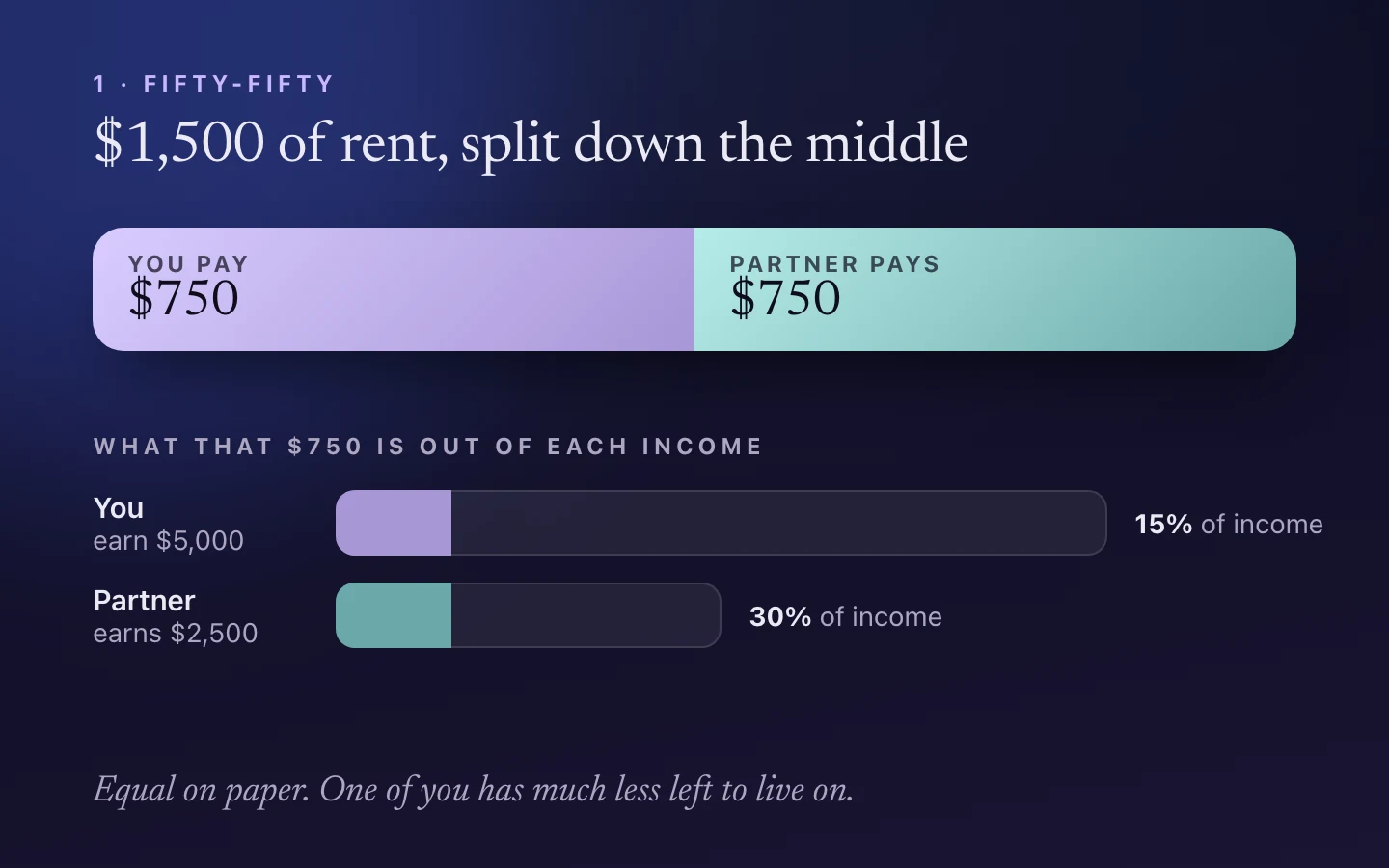
Every shared cost is split down the middle. Rent is $1,500, so you each pay $750. The grocery shop is $120, so you each pay $60.
Why couples like it: it’s simple, it’s easy to explain, and it feels equal. Nobody has to share their salary.
Where it strains: when incomes are far apart. If one partner earns $5,000 and the other $2,500, a $750 share of rent is 15% of one income and 30% of the other. On paper it’s equal. In practice, one of you has much less left to live on.
Best for: couples with similar incomes, or couples early on who want to keep finances separate.
2. Proportional to income
Each of you pays the same share of your income, not the same amount. Add your monthly take-home pay together, and work out what part of it each of you brings.
Say one of you takes home $3,000 and the other $2,000. Together that’s $5,000, so the split is 60/40. On $1,500 of rent, that’s $900 and $600. On a $120 grocery shop, $72 and $48.
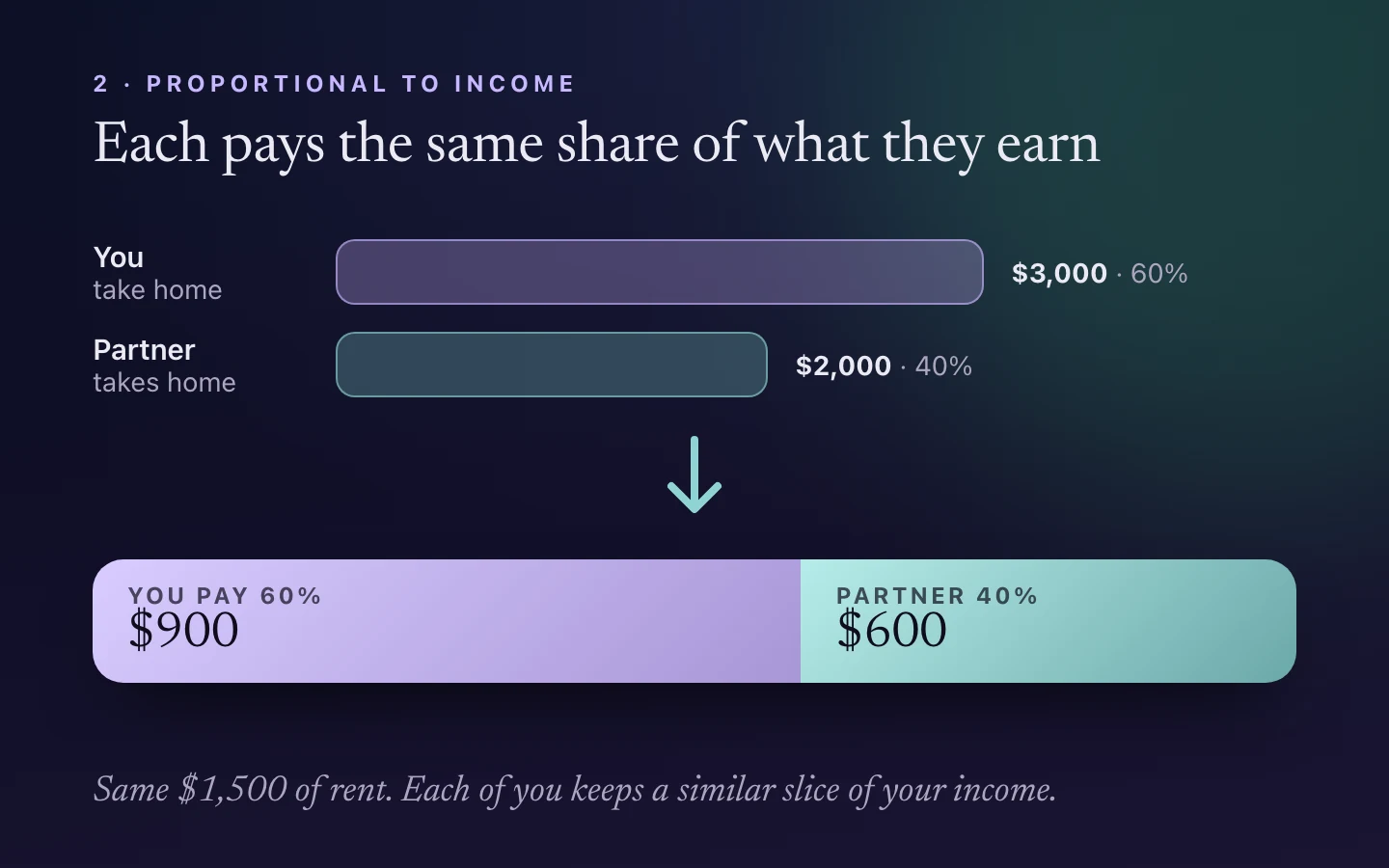
Why couples like it: it feels fair when incomes differ. Each of you gives up the same proportion of what you earn, so both of you keep a similar slice for yourselves.
Where it strains: it needs a bit more math, and it needs updating when an income changes. It also asks you to be open about what you earn, which some couples find harder than the math.
A gentler variation: split in proportion to what each of you has left after your own fixed costs, like a student loan or a car payment. That’s fairer still when one of you carries more personal debt.
Best for: couples whose incomes are meaningfully different.
3. One shared pot
You open a joint account, or set aside a shared budget, and both pay into it every month. Rent, bills and groceries come out of the pot. Everything else stays personal, and nobody has to justify their own spending.
How much each of you puts in is up to you. Many couples use the proportional split from method 2 to decide the deposits. For example, if shared costs come to $2,400 a month and your split is 60/40, one of you pays in $1,440 and the other $960.
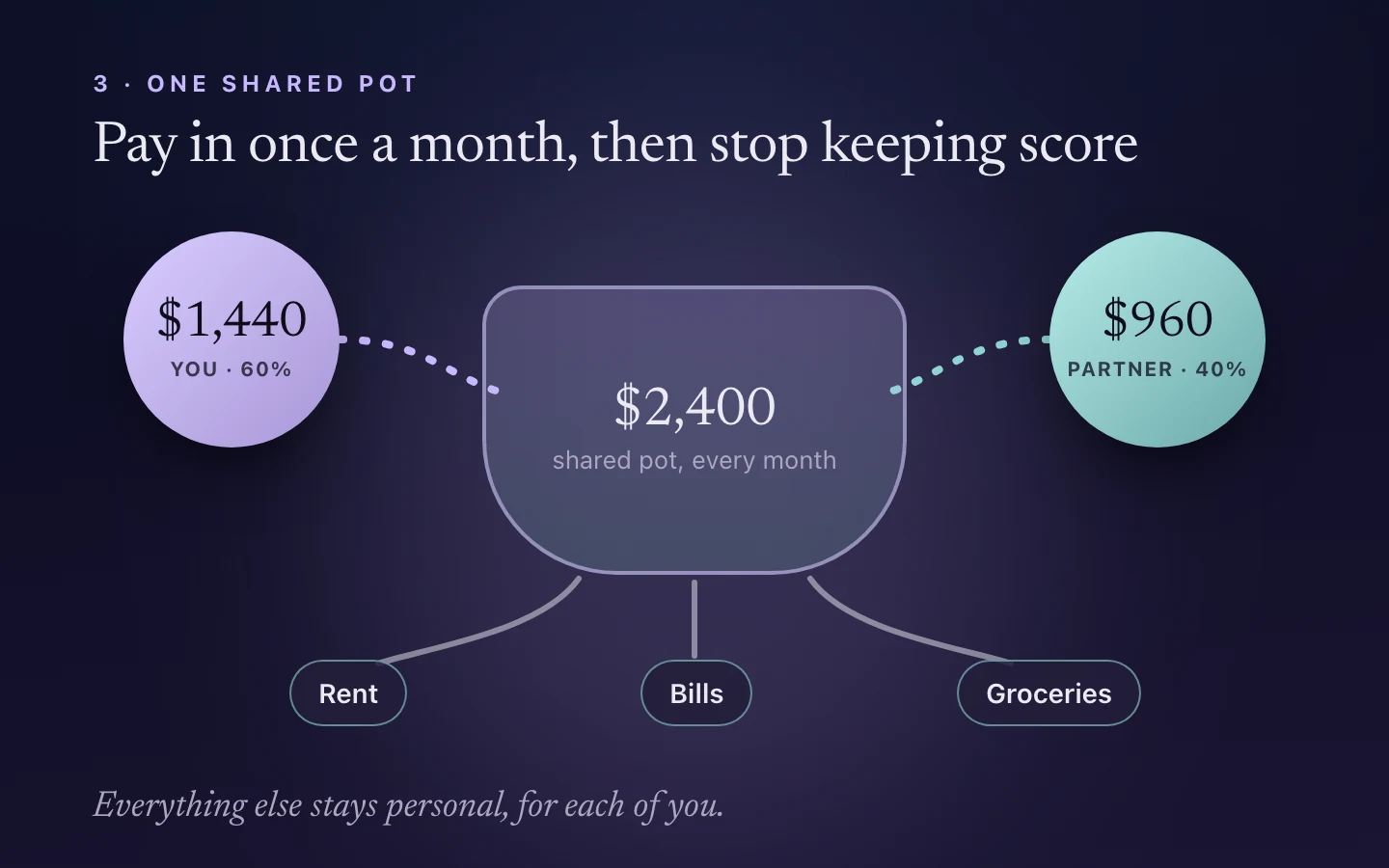
Why couples like it: day to day, there’s nothing to split. You stop keeping track of who paid for what, and money conversations happen once a month instead of at every checkout.
Where it strains: someone has to watch that the pot covers what it should. If it runs short, you need to agree on who tops it up.
Best for: couples who live together, share most costs, and want fewer small money conversations. It’s often called “yours, mine and ours”.
The three side by side
| Fifty-fifty | Proportional | Shared pot | |
|---|---|---|---|
| How it works | Every shared cost split equally | Each pays the same share of income | Both pay into one pot for shared costs |
| Feels fair when | Incomes are similar | Incomes differ | You share most costs |
| Effort | Low | Medium | Low day to day |
| Needs income talk | No | Yes | Usually |
How to have the conversation
- Pick a calm moment. Not right after a big bill arrives, and not in the middle of a disagreement.
- Start with what you both want, like saving for a trip or feeling less stressed, before you get to who pays what.
- Try it for three months, then look at it again. A method that sounded fair can feel different in practice, and that’s fine.
- Keep some money personal. Whichever method you choose, each of you having money you don’t need to explain does a lot for peace at home.
Keeping it fair without keeping score
The method is only half of it. The other half is seeing what you actually spend together. A shared list of expenses, looked at once a month, turns “I feel like I always pay” into a clear picture you can both see, and most of the tension goes away when the numbers are in front of you both.
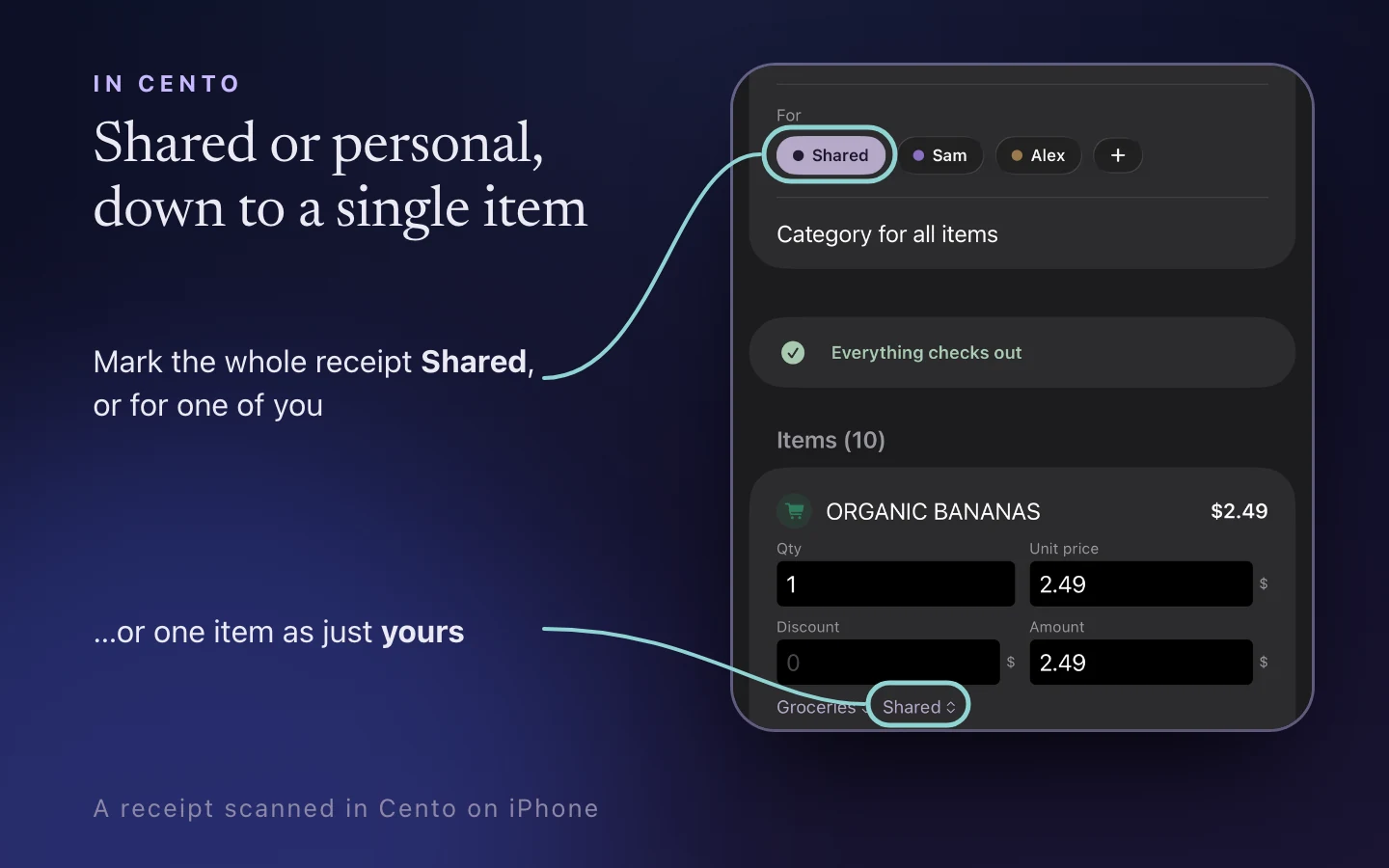
That’s what we built Cento for. You can mark each expense as shared or personal, scan a receipt and split it item by item when one of you bought something just for yourself, and see the shared total on both phones, Android or iPhone. Shared households are part of Cento Premium, and your expenses stay on your own phone unless you choose to share a household.
Whichever way you split, the best method is the one you both agreed on.